
 Tom Zargaj
1 min read
How to Choose the Right ERP Partner: Your Guide to a Smooth ERP Implementation
 Tom Zargaj : Jul 1, 2026, 10:27:40 AM
The average ROI for an ERP project is 52%. This means that for every $1 invested in an ERP system, there is an average return of $1.52. While this figure is promising, it also highlights a reality: many organizations are still leaving significant value on the table.
The real opportunity lies in treating ROI as a continuous discipline, not a one-time calculation, and using it to guide every decision from vendor selection to post-launch optimization. When ROI is approached as an ongoing metric, it becomes a powerful tool for connecting technology investments with business outcomes.
This mindset ensures that every dollar spent is justified by tangible improvements in productivity, cost savings, and revenue growth. By building a comprehensive ROI model, organizations can move beyond surface-level calculations and unlock the full potential of their ERP investment.
This guide covers:
P.S. Maximizing the ROI of your NetSuite investment starts with a clear, data-driven evaluation. Our team specializes in helping organizations quantify ERP system return on investment, identify cost savings, and build a business case that stands up to scrutiny. Contact us for an ROI evaluation or start your 14 Day Free NetSuite Trial to see how your investment can drive measurable results.
| Key Insight | Detailed Explanation |
|---|---|
| ROI Formula for ERP | Use (Total Value of Investment – Total Cost of Ownership) / Total Cost of Ownership × 100%. This expresses ROI as a percentage, showing how much value your ERP system delivers relative to its total cost. |
| What to Include in Costs | Capture software licenses or subscriptions, implementation services, training, integrations, ongoing support, upgrades, and opportunity costs. Missing hidden costs can distort your ROI calculation and lead to poor decisions. |
| Quantifying Benefits | Include direct cost savings, productivity improvements, revenue growth, and compliance gains. Don’t overlook intangible benefits like improved brand equity, customer trust, and decision-making speed, which can be estimated using proxy metrics or surveys. |
| Cloud vs. On-Premise ROI | Cloud-based ERP systems often deliver faster ROI due to lower upfront costs and quicker deployment, but long-term ROI depends on usage, scalability, and ongoing subscription fees. On-premise systems require a higher initial investment but may offer different cost structures over time. |
| Common ROI Pitfalls | Underestimating the total cost of ownership, ignoring change management, failing to track key performance indicators, and over-customizing the system can all undermine your ROI projections and actual returns. |
| Maximizing ROI Post-Go-Live | Set clear KPIs, invest in ongoing user training, regularly review processes, and leverage automation to drive continuous improvement and higher returns from your ERP investment. |
| Using ROI Calculators | ERP ROI calculators can help model scenarios, but their accuracy depends on the quality of your input data and your ability to capture both tangible and intangible benefits. Use them as a guide, not a substitute for strategic analysis. |
| Building a Business Case | A robust ROI analysis is essential for justifying your ERP investment to stakeholders, aligning the project with business goals, and ensuring accountability for results. |
As organizations move through the ERP lifecycle, a comprehensive ROI analysis provides clarity at every stage. It helps teams compare ERP vendors, prioritize features, and allocate resources where they will have the greatest impact. By quantifying both direct and indirect benefits, companies can build a business case that resonates with stakeholders and withstands scrutiny from boards and investors.
Failing to calculate ERP ROI or relying on incomplete models can lead to costly missteps. Without a clear understanding of the total cost of ownership and the full spectrum of benefits, organizations risk underestimating implementation costs, overestimating payback periods, or missing out on opportunities to automate operating costs and drive revenue growth. In a landscape where ERP systems also help improve brand equity and customer satisfaction, a robust ROI model is essential to maximizing the value of your investment.
Read Next: NetSuite Total Cost of Ownership: What Licensing Quotes Don’t Tell You
Building a reliable ROI model for ERP investments involves a thoughtful process of identifying every relevant cost, quantifying a wide range of benefits, and understanding how these elements interact over time. By approaching ROI as a comprehensive, evolving metric, organizations can make more informed decisions and adapt their strategies as business needs change.
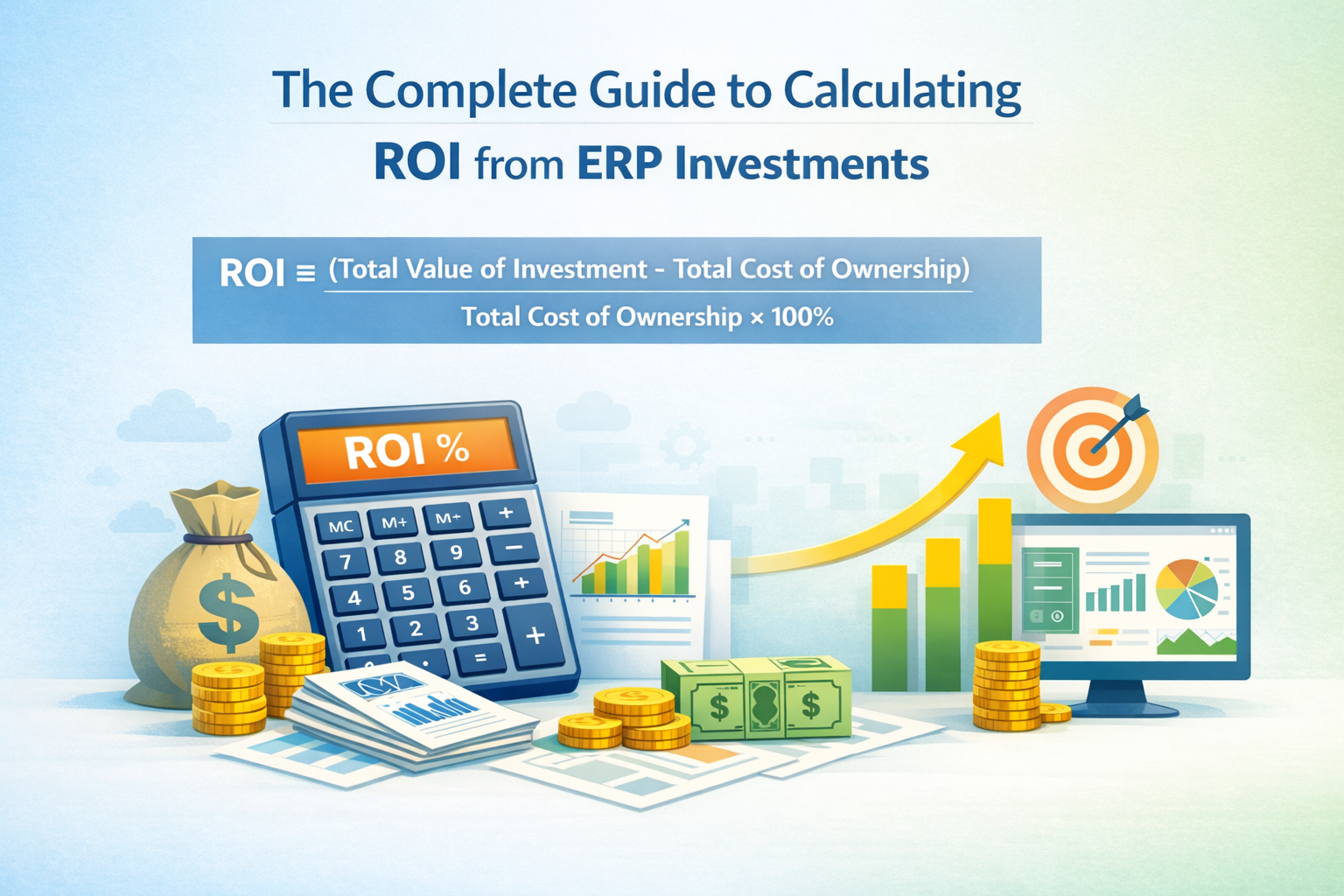
A strong ROI model begins with a clear formula, but the real value comes from understanding what each component means for your business. The most widely used formula is:
ROI = (Total Value of Investment – Total Cost of Ownership) / Total Cost of Ownership × 100%
This formula is more commonly used to calculate the ROI of an ERP system as a percentage, allowing you to compare the value delivered against the total cost of the investment. For more nuanced analysis, organizations may also use metrics like payback period (how long it takes to recoup the investment), internal rate of return (IRR), or net present value (NPV) to evaluate long-term returns and risk.
The ROI formula is only as accurate as the data you feed into it. That means capturing every relevant cost, from software and implementation to training and ongoing support, as well as quantifying all benefits—both tangible and intangible. By treating ROI as a dynamic metric, you can revisit your calculations as your ERP system matures, ensuring your business case remains grounded in reality.
A thorough ROI analysis requires a detailed accounting of every cost associated with your ERP investment. Overlooking even a single category can skew your results and lead to poor decision-making. Each cost should be evaluated for its impact on both the initial implementation and the ongoing operation of your ERP system.
Read Next: NetSuite Financial Management Modules: Everything Finance Teams Need to Know
When evaluating ERP ROI, it’s important to look beyond direct cost savings and consider the broader impact on business performance. Benefits can be both tangible, such as reduced operating costs, and intangible, such as improved brand reputation or faster decision-making. By capturing a full spectrum of benefits, organizations can build a more accurate and persuasive ROI model.
| Benefit | What It Is & Why It Matters | How to Quantify or Estimate |
|---|---|---|
| Cost Savings | Reduction in manual processes, lower error rates, and streamlined operations that decrease operating costs. | Compare pre- and post-implementation expenses for labor, materials, and overhead. Use historical data to estimate annual savings. |
| Productivity Improvements | Enhanced efficiency in business processes, faster reporting, and improved resource allocation. | Measure changes in order fulfillment time, reporting cycles, and employee output. Track KPIs like inventory turnover and payroll processing time. |
| Revenue Growth | Increased sales, faster time-to-market, and improved customer retention are enabled by better data and automation. | Analyze sales trends, customer acquisition rates, and repeat business before and after ERP implementation. |
| Compliance and Risk Reduction | Improved ability to meet regulatory requirements, reduce audit risk, and maintain data integrity. | Track compliance incidents, audit findings, and time spent on regulatory reporting. Estimate avoided penalties or fines. |
| Improved Brand Equity | Enhanced reputation with customers and partners due to reliable service, faster response times, and data-driven decision-making. | Use customer satisfaction surveys, Net Promoter Scores, or market share analysis as proxy metrics. |
| Better Decision-Making | Real-time access to accurate data enables faster, more informed decisions across the organization. | Survey managers on decision-making speed and confidence. Track cycle times for key business decisions. |
| Scalability and Flexibility | Ability to support business growth, adapt to new markets, and integrate with emerging technologies. | Evaluate the cost and time required to add new users, locations, or business units. Assess readiness for future expansion. |
Calculating ERP ROI in practice requires gathering data, applying the ROI formula, and interpreting the results. Begin by assembling a cross-functional team to identify all relevant costs and benefits, drawing on finance, operations, IT, and business unit leaders. Use historical data, industry benchmarks, and input from ERP vendors to estimate values where direct measurement isn’t possible.
Once you have a comprehensive list, plug the numbers into your ROI formula. For example, if your total ERP investment is $800,000 and you project $1,200,000 in net benefits over three years, your ROI would be:
($1,200,000 – $800,000) / $800,000 × 100% = 50%
This means your ERP system delivers a 50% return on the total cost of ownership. Interpreting this result requires context: compare it to your company’s internal rate of return targets, payback period expectations, and the ROI of alternative investments. Use the analysis to guide decisions on ERP selection, scope, and ongoing optimization.
The deployment model and system age can significantly influence both the speed and magnitude of ERP ROI. Understanding these differences helps organizations make informed choices and set realistic expectations for payback and long-term value.
Even the most sophisticated ROI models can be undermined by common mistakes. Recognizing these pitfalls early helps organizations avoid costly surprises and ensures that ROI projections remain credible and actionable.
One frequent error is underestimating the total cost of ownership by focusing solely on upfront expenses and neglecting ongoing support, upgrades, and change management. Another risk is failing to define clear success metrics or key performance indicators, which makes it difficult to track progress and hold teams accountable. Over-customizing the ERP system can drive up costs and complicate future upgrades, while ignoring the human side of change, such as user adoption and training, can limit the realization of projected benefits.
To maintain the integrity of your ROI analysis, revisit your assumptions regularly, update your models as new data becomes available, and engage stakeholders from across the organization in the process. This approach ensures that your ROI calculations reflect the true business value of your ERP investment.
Read Next: NetSuite ERP Implementation Checklist: Avoid Costly Mistakes & Stay on Track
Read Next: How to Overcome 6 Common ERP Implementation Challenges
ERP ROI calculators can be valuable to model different investment scenarios, but their usefulness depends on the quality of your input data and your understanding of the underlying assumptions. When selecting or building an ROI calculator, look for features that allow you to customize cost and benefit categories, adjust time horizons, and incorporate both tangible and intangible returns.
A compelling business case for ERP investment consists of clear objectives, measurable outcomes, and a direct connection to strategic priorities. By aligning ROI analysis with the organization’s most important goals, leaders can secure executive buy-in, allocate resources effectively, and ensure ongoing accountability for results.
Start by clarifying the business objectives your ERP system is meant to achieve, such as automating operating costs, supporting revenue growth, or enabling compliance with new regulations. Connect these objectives to specific, measurable outcomes, like reduced order-to-cash cycle time or improved inventory turnover, that can be tracked over time. By linking ROI projections to broader business priorities, you ensure that your ERP investment is positioned as a driver of enterprise resource planning success, not just a technology upgrade.
Read Next: NetSuite for Small Business: ERP Benefits, Pricing, and SMB Fit
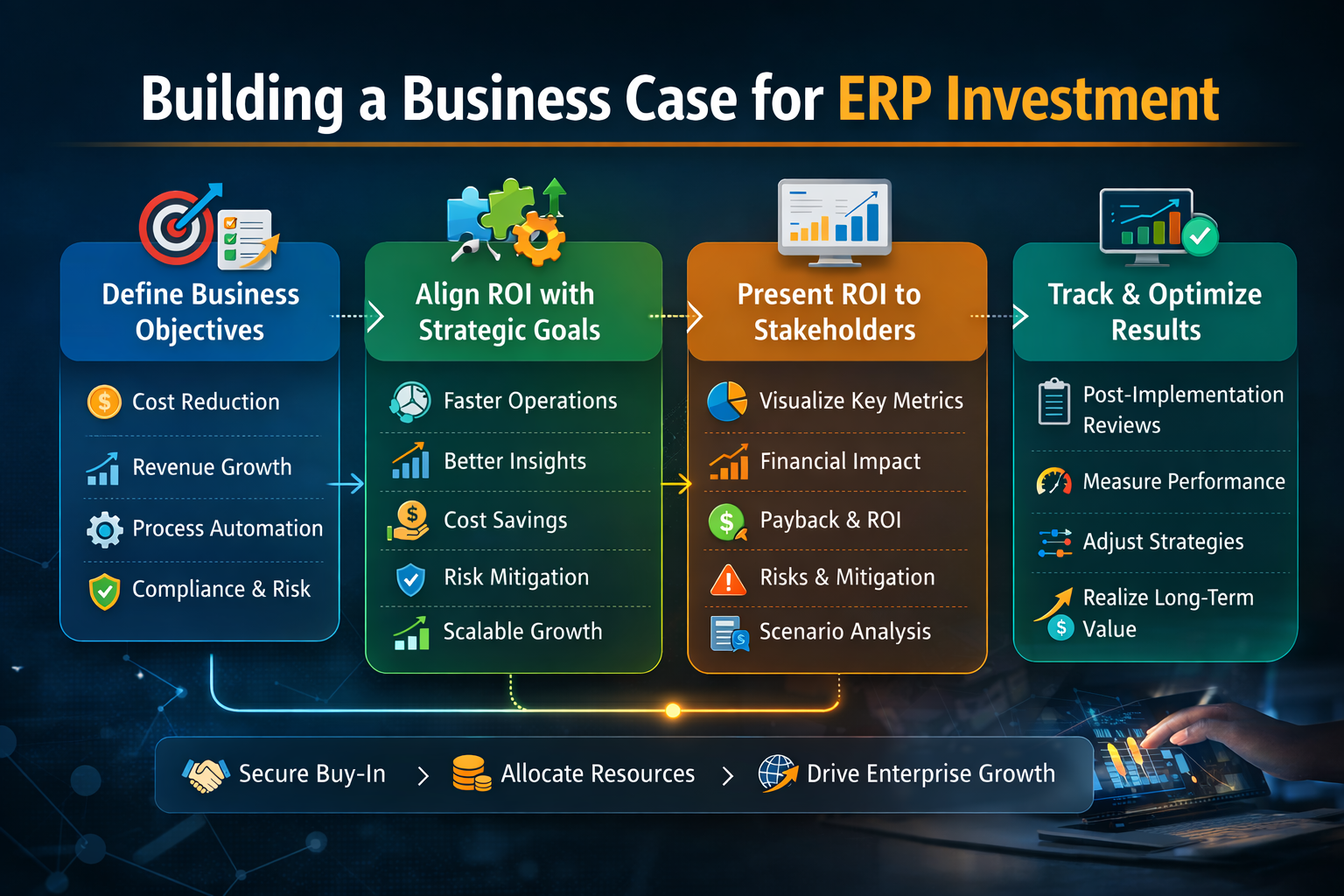
ROI analysis gains power when it’s directly tied to the organization’s most important priorities. This means translating high-level goals into operational metrics that can be measured, tracked, and optimized as the ERP system matures.
For example, if revenue growth is a top priority, focus on how the ERP system will enable faster order processing, better customer insights, and improved sales forecasting. If cost savings are critical, highlight automation of manual tasks, reduction in error rates, and streamlined procurement processes. Compliance and risk management objectives can be supported by demonstrating how the ERP system will centralize documentation, automate reporting, and reduce audit exposure.
By making these connections explicit, you create a business case that resonates with stakeholders and provides a roadmap for ongoing ROI realization.
Effectively communicating ERP ROI to stakeholders requires financial rigor and compelling storytelling. The goal is to make the business value of your ERP investment clear, relatable, and actionable for decision-makers across the organization.
Read Next: ERP Digital Transformation with NetSuite: Key Strategies
After an ERP system goes live, the work of maximizing ROI is just beginning. Organizations that excel in this area treat their ERP as a living asset, embedding ROI tracking into their operating rhythm and making continuous improvement a core part of their strategy. This approach ensures that the system continues to deliver value as business needs evolve and new opportunities emerge.
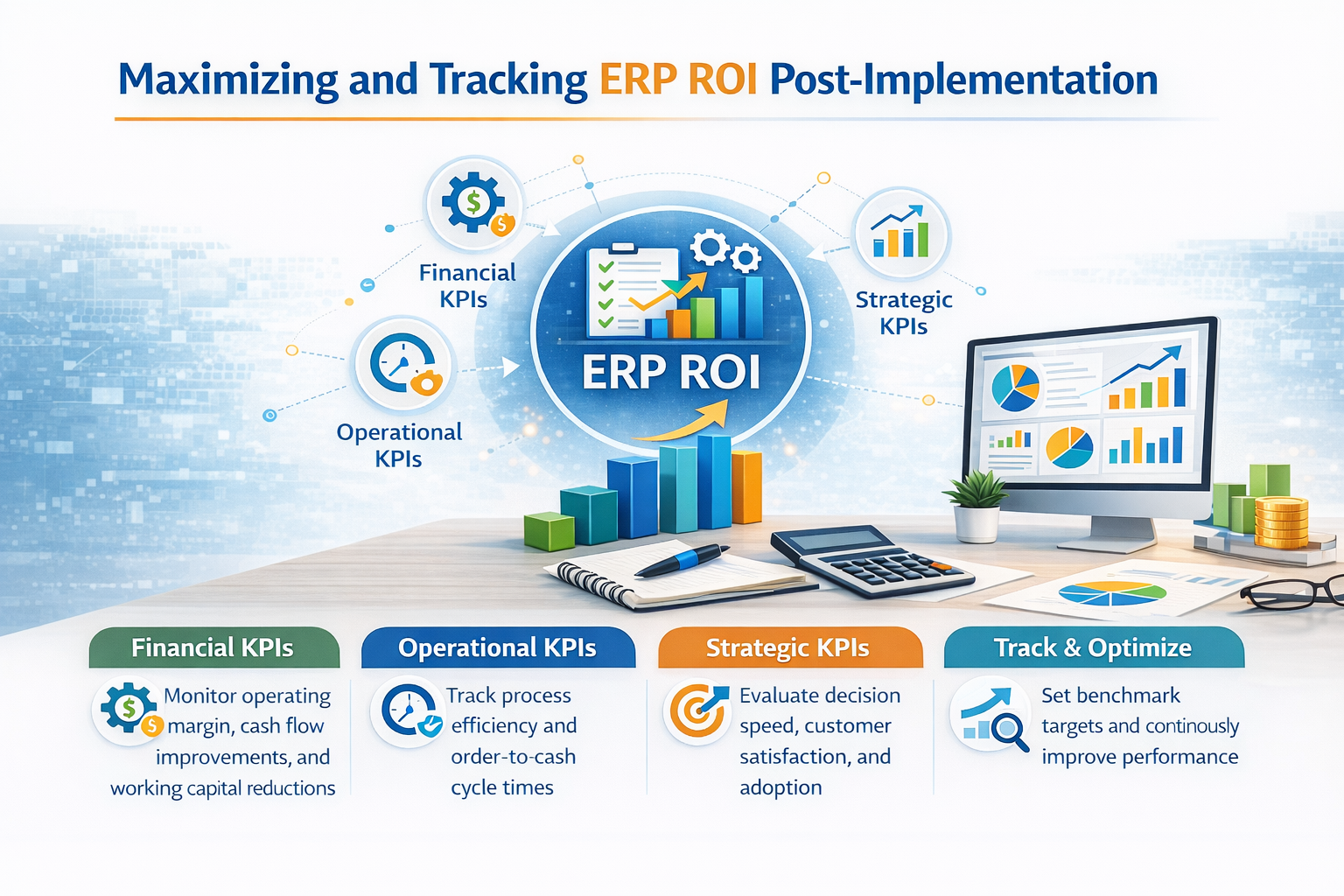
Defining the right metrics is essential to tracking ERP ROI and holding teams accountable for results. These key performance indicators should span financial, operational, and strategic dimensions, providing a holistic view of system impact.
Read Next: Is Your ERP Reporting Fast Enough for Real-Time Decisions?
Continuous improvement is the engine that sustains and grows ERP ROI over the long term. Organizations that prioritize this mindset regularly assess their processes, seek feedback from users, and stay alert to new features or automation opportunities that can drive additional value. By fostering a culture of learning and adaptation, companies can ensure their ERP system remains aligned with evolving business goals.
To keep momentum, invest in ongoing user training so employees can fully leverage new system capabilities. Schedule periodic process reviews to identify bottlenecks, inefficiencies, or areas where automation could further reduce costs or speed up workflows. Maintain an open line of communication with your ERP vendor and implementation partner to stay informed about best practices, product updates, and emerging technologies. This proactive approach helps organizations adapt to market changes, regulatory shifts, and internal growth, ensuring that ERP ROI remains strong year after year.
Read Next: NetSuite SuiteFlow Automation Workflows: A Practical Guide
As ERP technology evolves, so do the methods for measuring and maximizing ROI. Advanced perspectives on ERP ROI include strategies for quantifying intangible benefits, leveraging automation and AI, and integrating ROI analysis with broader business transformation initiatives. By exploring these areas, organizations can unlock new sources of value and stay ahead of the curve in a rapidly changing landscape.
While tangible benefits like cost savings and productivity improvements are straightforward to measure, intangible gains can be equally significant in driving long-term business value. Estimating the impact of improved brand equity, customer trust, or employee morale requires creativity and rigor.
One approach is to use proxy metrics, such as Net Promoter Score, customer retention rates, or employee engagement surveys, to capture changes in perception and behavior. These metrics can then be linked to financial outcomes, such as increased sales or reduced turnover, providing a basis for including intangibles in your ROI model. By making these connections explicit, you ensure that your ROI analysis reflects the full spectrum of benefits delivered by your ERP investment.
Read Next: How NetSuite CRM Transforms Customer Service and Strengthens Loyalty
Modern ERP systems increasingly incorporate automation and artificial intelligence to accelerate ROI and unlock new sources of value. These technologies streamline workflows, reduce manual errors, and provide predictive insights that drive smarter decision-making.
Read Next: AI and Automation in ERP Systems: Key Features and What to Expect Next
As you reflect on your ERP strategy, it’s clear that building a robust ROI model is a commitment to ongoing value creation. By capturing every relevant cost, quantifying both tangible and intangible benefits, and aligning your analysis with business goals, you create a foundation for confident decision-making and sustained business growth. The journey goes beyond implementation; ongoing measurement, continuous improvement, and proactive management are essential to maximizing the ROI of your new ERP system.
Moving forward, partnering with a team that understands both the technical and business dimensions of ERP ROI can make all the difference. Centium brings deep expertise in NetSuite solutions, helping organizations streamline operations, optimize workflows, and drive measurable business growth. Contact us for an ROI evaluation to unlock the full value of your ERP investment and position your business for long-term success.
ROI for ERP is calculated using the formula: (Total Value of Investment – Total Cost of Ownership) / Total Cost of Ownership × 100%. This approach requires a comprehensive accounting of all costs (software, implementation, training, support) and benefits (cost savings, productivity, revenue growth, compliance). The result is expressed as a percentage, indicating the return generated for every dollar invested.
A thorough ROI of ERP calculation should include software licenses or subscriptions, implementation services, training and onboarding, custom development, integrations, ongoing support, upgrades, change management, and opportunity costs. Capturing all these elements ensures your ROI model reflects the true total cost of ownership.
Intangible benefits like improved brand equity or customer trust can be estimated using proxy metrics such as Net Promoter Score, customer retention rates, or employee engagement surveys. These metrics can be linked to financial outcomes, allowing you to include them in your ROI analysis alongside tangible benefits.
Cloud-based ERP systems typically offer faster ROI due to lower upfront costs and quicker deployment, but ongoing subscription fees must be factored into the total cost of ownership. On-premise systems require higher initial investment and dedicated IT resources for maintenance, which can affect long-term ROI calculations.
Common pitfalls include underestimating the total cost of ownership, failing to define clear KPIs, over-customizing the system, and neglecting change management. Regularly revisiting your ROI model and engaging stakeholders from across the organization can help avoid these mistakes.
Yes, small businesses can achieve positive ROI from ERP investments, especially with modern cloud-based solutions that offer scalability and lower upfront costs. The key is to right-size the implementation, focus on high-impact areas, and track both tangible and intangible benefits over time.

1 min read
Tom Zargaj : Jul 1, 2026, 10:27:40 AM

1 min read
Tom Zargaj : Feb 13, 2026, 10:00:00 AM
Managing a global business requires more than spreadsheets and regional accounting tools. Every time you expand into a new country, you take on new...

1 min read
Tom Zargaj : Jan 9, 2026, 3:00:00 PM
Are your systems holding you back?